

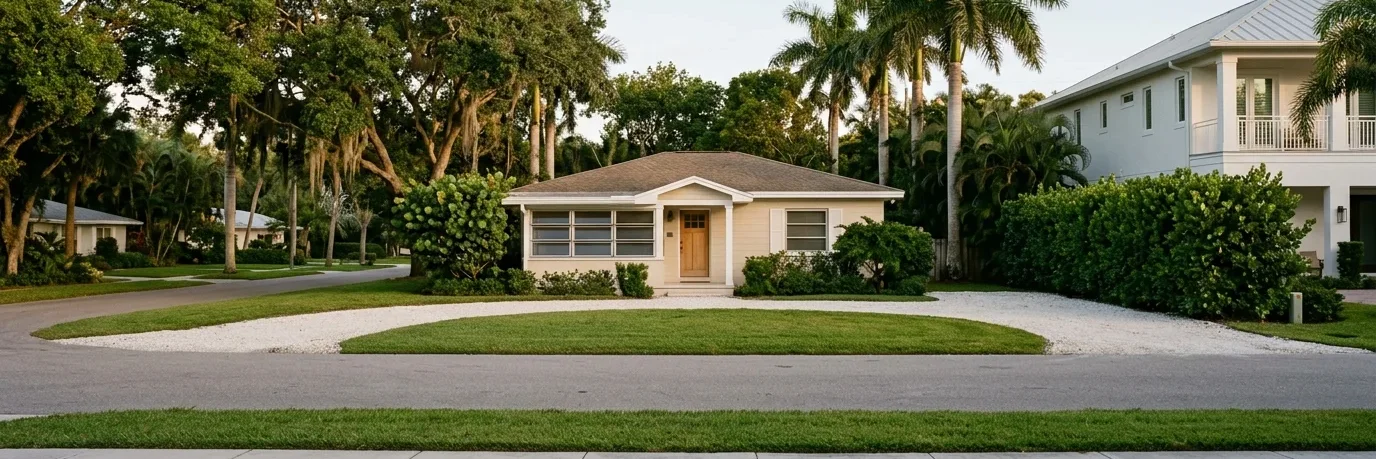
When you buy a teardown in Olde Naples, the Moorings or Coquina Sands, you are buying the land and its position, and the house on it is usually a cost to remove rather than an asset. Before you close, the lot has to clear a specific sequence of checks: the survey, the flood zone and base flood elevation, City of Naples zoning, deed restrictions, trees, utilities, the seawall if it is on the water, the Coastal Construction Control Line if it is on the Gulf, and the demolition permit.
I’m Joe Belz, a Broker Associate at Compass and the lead agent of Joe Belz + Apex Team. My own development company, Belz Properties, developed about 20 homes in these three neighborhoods.
A teardown buyer shops for an older home they have no intention of living in. Done well, it ends with a new home on a lot you chose. Done in a hurry, it can bring expensive surprises.
Why buyers rebuild in these three neighborhoods
The short answer is location that cannot be manufactured. These are established neighborhoods inside the City of Naples, close to the Gulf and close to downtown. Three things push buyers toward rebuilding rather than renovating.
Position. In Olde Naples, the numbered avenues and streets put you within walking distance of Fifth Avenue South and Third Street South, downtown’s shopping and dining streets, and of the beach ends at the west end of the avenues. The historic Naples Pier sits at the west end of 12th Avenue South; as of October 2026 the City lists it as closed for the Naples Pier Rebuild Project. Cambier Park is just south of Fifth Avenue South. In the Moorings and Coquina Sands, the draw is the Gulf beach and the canals and bays of the Moorings Bay system.
Housing stock. Many homes on these streets were built decades ago, to earlier codes and earlier flood maps. The City of Naples states that over 90 percent of its addresses are within the Special Flood Hazard Area. For an older house whose lowest floor sits below today’s required flood elevation, a major renovation can trigger the 50 percent rule, and the conversation shifts from remodeling to rebuilding.
Product. Some buyers in this part of the market want today’s layout, systems and construction standards on a lot they chose. Updating an older house cannot always deliver that. Starting over can.
How Olde Naples, the Moorings and Coquina Sands differ
Figuring out what part of town you want to live in is critical. These are three different lot markets.
Olde Naples
Olde Naples is the grid of numbered avenues and streets around the downtown core, with Gulf-front lots along Gulf Shore Boulevard and beach ends where the avenues meet the sand. Along this stretch the City has been restoring public beach accesses and replacing or building beach end seawalls at avenues including 3rd, 14th, 15th and 16th Avenue South. The appeal is walkability. The trade-offs: lots can vary block to block in size and shape, older structures can raise historic questions (the City’s demolition permit application asks whether a structure is historic), and a Gulf-front lot brings in the Coastal Construction Control Line. In July 2026, I was on the listing side of a new-construction home in Olde Naples that sold for $15.1 million.
The Moorings
The Moorings is organized around water. The City’s Moorings Bay Special Taxing District was set up in 1987, after the area was annexed into the City, to improve water quality and navigability and to fund maintenance dredging in the canals and waterways of the Moorings Bay system, including Doctors Pass. On a canal or bay lot, the seawall belongs at the top of your checklist. In January 2026, I represented the buyer of an $18.3 million new-construction home in the Moorings.
Coquina Sands
The City’s neighborhood planning list for Coquina Sands runs from Gulf Shore Boulevard North to US 41, on streets such as Oleander Drive, Orchid Drive and Banyan Boulevard. The Coquina Sands subdivision is named within the Moorings Bay Special Taxing District, so its waterfront lots on that bay system share the Moorings’ seawall and navigation questions. Coquina Sands, the Moorings and Park Shore share a geographic area in our MLS, and of those three, Coquina Sands has the fewest residences.
More on each area: Olde Naples, the Moorings, Coquina Sands and living on the water in Naples.
The due diligence sequence before you close on a lot
Work through a teardown in this order, because the early checks decide whether the later ones are worth paying for. Each step tells you where the official answer lives.
1. Confirm the lot is inside the City of Naples
City rules apply only inside the city limits. The City lists Old Naples, the Moorings and Coquina Sands in its neighborhood program, but neighborhood names are informal, and the City’s own flood map page sends owners outside the city limits to the county or FEMA maps. Confirm the address with the City’s zoning map or its Building Department at (239) 213-5020.
2. Survey and boundary
Order a current boundary survey early. It fixes the lot’s dimensions, area, easements and encroachments, and it is the base for your architect’s work. You will need it anyway: the City’s complete demolition checklist requires a boundary survey before demolition, including lot width and lot area, and another after demolition with a grading plan and elevations showing how the property will drain.
3. Flood zone, base flood elevation and the new floor height
This is the check that shapes the house. FEMA defines the base flood elevation as the elevation of surface water resulting from a flood that has a 1 percent chance of equaling or exceeding that level in any given year. The City of Naples states that its 2024 Flood Insurance Rate Maps, effective February 8, 2024, are in effect for construction and insurance purposes, that all new construction must at a minimum comply with the flood provisions of the current Florida Building Code, and that the first livable floor should be at or above the base flood elevation. The Florida Building Code’s residential flood provisions go further: they set the lowest floor at the base flood elevation plus 1 foot, or the design flood elevation if that is higher, and in a coastal high hazard area such as Zone VE they apply that height to the bottom of the lowest horizontal structural member. In Zone X, section 16-144 of the City’s Floodplain Management Code says the flood elevation must be equivalent to 18 inches above the average crown of the adjacent roads.
In practice, the lowest floor of your new house has to meet the required flood elevation for that parcel, which can put the living level well above the street and shapes the entry, stairs, elevator, pool deck, fill and drainage, and cost. Look the lot up on the City’s flood map tool or the FEMA Flood Map Service Center, and read the City’s floodplain information pages. The City advises confirming flood information with an official flood zone determination from a Florida licensed engineer, architect or surveyor before you buy or build. FEMA issued preliminary maps for Collier County and the City of Naples on March 20, 2025. They are not in effect, and Collier County targets summer 2027 for the new map to take effect, a date subject to change, so look at the preliminary map as well before you design. I cover this in depth in First Floor Elevation, Flood Zones and Insurance for Naples Homes.
4. Zoning district, setbacks and building height
Every lot in the City sits in a zoning district that sets setbacks from each property line, building height, lot coverage and more. Those numbers vary by district and lot. The City’s Planning Department says you can find a property’s zoning district on the City’s zoning map, and that the Code of Ordinances, including the Land Development Code, is on Municode. Planning is at (239) 213-1050, and an owner can request a zoning confirmation letter. Have your architect run a zoning analysis on the actual survey before you close. Buildable area, not lot area, is what you are paying for.
5. Deed restrictions and covenants
Some lots carry recorded deed restrictions, and some sit within an association with its own architectural review. The City’s demolition checklist itself tells applicants to check deed restrictions because association approval may be required. Ask your title company for the recorded restrictions early and read them with your architect.
6. Trees
Chapter 38, Tree Protection, of the City’s Code of Ordinances governs city trees, which include any tree standing in whole or in part within a public right-of-way. The City’s demolition checklist requires a Tree Alteration Permit before any city tree is altered or removed, warns that removing protected trees can bring penalties from the City and the Florida Fish and Wildlife Conservation Commission, and notes that bald eagle nesting season runs October 1 through May 15. Separately, Section 163.045, Florida Statutes, bars a local permit requirement for removing a tree on residential property when an ISA certified arborist or Florida licensed landscape architect documents that it poses an unacceptable risk; the City amended its ordinance in 2020 to reflect that law. Walk the lot with your architect before you design around or through a tree.
7. Utilities
The City of Naples Utilities Department maintains the public water, sewer and irrigation infrastructure. On a teardown, the demolition checklist requires the existing sewer lateral to be capped and lets the water meter stay on site if properly protected, or be removed and reinstalled for a fee through Utilities Permitting. It also reminds contractors to call Sunshine at 1-800-432-4770 48 hours before digging. Ask what service the new house will need before you design it.
8. Seawall and dock, if the lot is on the water
On a canal or bay lot, the seawall is part of what you are buying, and replacing one is a major project with its own engineering and permits. Have a marine contractor or engineer inspect the seawall, cap, tiebacks and dock during your inspection period, and ask for permit and repair history. The City’s Moorings Bay Special Taxing District page includes a seawall owners manual (a City of Marco Island publication shared with permission). Ask the City which permits apply to the work you have in mind, since state and federal approvals can also be involved.
9. The Coastal Construction Control Line, if the lot is on the Gulf
The Florida Department of Environmental Protection describes the Coastal Construction Control Line as the landward extent of the damaging effects of a 100-year storm, and under Section 161.053, Florida Statutes, construction seaward of the line needs the Department’s authorization. The City states that the CCCL through Naples was established on June 28, 1989, and that a Coastal Construction Setback Permit is required for new construction, excavation, fill, repair of shoreline protection structures and other activities seaward of it, in addition to building permits. DEP’s Map Direct tool shows where the line sits relative to a property.
10. The demolition permit
According to the City’s complete demolition checklist:
- Where required, a temporary construction fence must be permitted, installed and inspected before the demolition permit is released.
- Notification and offer letters go to adjacent owners, and the permit is released 14 days from the date of notice.
- Demolition permits expire within 30 days of issuance, and a final inspection is needed before other permits are issued.
- An asbestos survey must be filed with the Florida Department of Environmental Protection for any demolition in a building that contains asbestos.
- Demolition seaward of the CCCL or within sight of the beach that needs temporary lighting must comply with the City’s sea turtle lighting rules.
A lot is not ready the day after closing. Build the permitting time into your plan.
Looking at a lot in Olde Naples, the Moorings or Coquina Sands?
Send me the address. I will walk you through what I would check first and in what order, before you commit to an inspection period or a design team.
Contact JoeRenovate or rebuild: the 50 percent rule
Many buyers start by asking whether they can keep the house and renovate. In a flood zone, the answer often turns on what people in Naples call the 50 percent rule.
FEMA defines substantial improvement as any reconstruction, rehabilitation, addition or other improvement of a structure for which the cost of the work equals or exceeds 50 percent of the market value of the structure before the improvement starts, and defines substantial damage the same way against the cost of restoring a damaged structure. The City of Naples uses the same threshold and states that a substantially improved or substantially damaged building must be brought into compliance with its flood damage prevention regulations, including elevating it to or above the base flood elevation. The City also says substantial improvements must at a minimum comply with the flood provisions of the current Florida Building Code, whose residential provisions set the lowest floor at the base flood elevation plus 1 foot, or the design flood elevation if that is higher.
How the City measures it matters:
- It uses the assessed value of the structure recorded by the Collier County Property Appraiser, which excludes the land, the pool or spa and anything not a permanent part of the structure.
- An owner who disagrees may submit a depreciated replacement cost appraisal from a State of Florida licensed appraiser, dated no later than six months from permit submittal.
- The owner must submit a complete cost estimate signed by a licensed contractor, covering all improvements, not only structural work.
Where the land carries most of the value, a threshold measured against the structure alone can be reached by a remodel that does not look ambitious on paper. Once a project crosses it, you are elevating or rebuilding anyway. Price the renovation and the rebuild side by side with real contractor estimates, and talk to the City’s Floodplain Coordinator at (239) 213-5039 early, since the City makes the determination.
What this rule does not tell you
It does not tell you whether a house has flooded or will flood, and it does not set your insurance premium. Ask the seller directly whether the home took water, get the elevation certificate if one exists, and ask an insurance agent to quote the house you plan to build.
How to value a teardown
A teardown is priced as land. Here is how to build the number.
- Start with land comparables: recent sales of vacant lots and of houses bought and demolished in the same neighborhood, on similar streets. A finished home on the next street is a different product.
- Adjust for what makes a lot a lot: usable dimensions after setbacks, frontage, corner or interior position, orientation, water frontage and boat access, and distance to the beach or downtown.
- Subtract the cost of the house you remove: demolition, any asbestos work, capping utilities, surveys, fill and grading, and the carrying cost of the time.
- Account for what due diligence finds: a seawall near the end of its life, a tree that constrains the footprint, a restrictive covenant, a CCCL constraint.
- Work backward from the finished product: what a new home on that lot is likely to be worth, minus design, permitting, construction and carrying costs.
Land values here move with the specific street and season, so ask for recent land and teardown sales on the streets you are considering.
How a lot looks to a developer
I started in this business in new construction. I ran sales and marketing in Naples for Centex Homes, then worked as an Area Manager in Dallas overseeing sales and construction in an area building about 300 homes a year. Back in Naples, I handled sales for Sussex Homes and Naples Redevelopment on projects that included Olde Naples and Coquina Sands. Through Belz Properties I developed about 20 homes across Olde Naples, Coquina Sands and the Moorings, and over the years I have done about 80 deals in various capacities with one Naples builder.
- The survey and the flood map set the limits before the architect starts. The buildable envelope and required floor height decide more than any rendering.
- Bring an architect and a builder in before closing. Two of my closest friends are a Naples architect and a luxury home builder.
- Plan for the calendar. With a two to three year timeframe to buy, design and build, and very few homes under construction because many builders are sitting on inventory, I believe now is the time to start.
More on my background is on Meet Joe Belz, and on the development side of my work on Builder and Developer Services.
Buying a lot versus buying a builder’s spec home
On these streets you will often see two versions of the same opportunity: the older house as a teardown, and a builder’s spec home planned or under construction on a similar lot.
| Buying the lot | Buying a builder’s spec home | |
|---|---|---|
| Design control | Full: your architect, your plan | Whatever the builder still allows at that stage |
| Who carries the process | You: demolition, permits, elevation, construction | The builder |
| Timeline | The full buy, design and build cycle | Shorter, depending on construction progress |
| What you are pricing | Land, plus your design and construction costs | A finished home, with the builder’s margin included |
| Key diligence | The ten checks above | Permits, plans, warranty, independent inspections, inclusions |
Neither is automatically better. A buyer who wants a specific house and has the time usually buys the lot. A buyer who wants to be in sooner, or does not want to manage a build, is often better served by a spec home from a builder with a track record. The bigger picture of building here is in New Construction in Naples West of 41, and the questions to ask before any offer are in Naples Home Buyer Due Diligence.
Frequently asked questions
Yes. The City of Naples lists Old Naples, the Moorings and Coquina Sands among the neighborhoods in its Streets and Stormwater neighborhood program, and its Moorings Bay Special Taxing District page names the Coquina Sands, Moorings and Park Shore subdivisions. Neighborhood names are informal, so confirm any specific address with the City’s zoning map or Building Department before relying on City rules.
It is the substantial improvement standard used under the National Flood Insurance Program. The City of Naples treats work costing 50 percent or more of the structure’s pre-improvement market value as a substantial improvement, and a substantially improved building in a Special Flood Hazard Area must be brought into compliance with current flood rules, including elevation. The City measures structure value using the Collier County Property Appraiser’s assessed value, excluding land.
It depends on the lot. In a flood hazard area, the Florida Building Code’s residential flood provisions set the lowest floor at the base flood elevation plus 1 foot, or the design flood elevation if that is higher, and the base flood elevation comes from the effective Flood Insurance Rate Map for that parcel. Look the parcel up on the City’s flood map tool or the FEMA Flood Map Service Center, then have your architect confirm the requirement with the City’s floodplain review.
The City of Naples complete demolition checklist states that a demolition permit is released 14 days from the date of notice to neighboring property owners and that all demolition permits expire within 30 days of issuance. Where required, a temporary construction fence must be permitted, installed and inspected first, and boundary surveys are required before and after demolition.
It depends on where the tree stands and what it is. Chapter 38 of the City of Naples Code of Ordinances governs city trees, including any tree standing in whole or in part within a public right-of-way, and the City requires a Tree Alteration Permit before one is altered or removed. The City also warns that removing protected trees can bring penalties, so confirm with the City before cutting. Section 163.045, Florida Statutes, bars a local permit requirement for removing a tree on residential property when an ISA certified arborist or Florida licensed landscape architect documents that it poses an unacceptable risk.
The Coastal Construction Control Line, or CCCL, is a line set by the Florida Department of Environmental Protection under Section 161.053, Florida Statutes. The City of Naples says the line through Naples was established on June 28, 1989, and that a Coastal Construction Setback Permit is required for new construction, excavation, fill and other activities seaward of it, in addition to building permits.
Price it as land. Start with recent sales of comparable vacant lots and teardowns in the same neighborhood, adjusted for size, buildable area, frontage and water access. Subtract the cost of removing the existing house and preparing the site, and account for anything due diligence turns up, such as a seawall that needs work. Then test the price against what a finished new home on that lot is likely to be worth.
Related resources
Thinking about buying a lot to build on?
Whether you already have a lot in mind or are still choosing between Olde Naples, the Moorings and Coquina Sands, I am happy to talk through the land, the process and the timeline with you.
Contact JoeSources
- City of Naples, Building Department: Development in the Floodplain; Floodplain Information; Flood Zone Maps; Building or Modifying Concerns; Flood Mitigation Guidelines; Staff Directory; Demolition permit application and Complete Demolition Checklist (version 2026.10.01), naplesgov.com
- City of Naples: Planning and Zoning Information; Construction Seaward of the CCCL; Moorings Bay Special Taxing District; Old Naples, Moorings and Coquina Sands neighborhood pages; Tree Protection Ordinance and Chapter 38, Tree Protection; Utilities; Naples Pier; Cambier Park; Public Beach Accesses and Beach End Seawall Projects, naplesgov.com
- FEMA: Base Flood Elevation glossary; Substantial Damage and Substantial Improvement FAQ; Flood Map Service Center, fema.gov and msc.fema.gov
- Collier County, Proposed Flood Insurance Rate Map notice, August 19, 2026, collier.gov; FEMA, Proposed Flood Hazard Determinations, Federal Register, December 18, 2025, federalregister.gov
- Florida Department of Environmental Protection, Coastal Construction Control Line program, floridadep.gov
- Florida Division of Emergency Management, Flood Resistant Provisions in the 8th Edition Florida Building Code (2023), sections R322.2.1 and R322.3.2, floridadisaster.org
- Florida Statutes (2026), Sections 161.053 and 163.045, leg.state.fl.us
All sources accessed October 30, 2026.
Rules, maps and permit requirements change. This guide is general information about buying a lot to build on in Naples and is not legal, tax, insurance, engineering or financial advice, and nothing here describes the flood zone, zoning, elevation or buildability of any particular property. Confirm anything specific to a lot with the City of Naples, a Florida licensed surveyor, engineer or architect, your title company, an attorney and your insurance agent.
Social Cookies
Social Cookies are used to enable you to share pages and content you find interesting throughout the website through third-party social networking or other websites (including, potentially for advertising purposes related to social networking).