

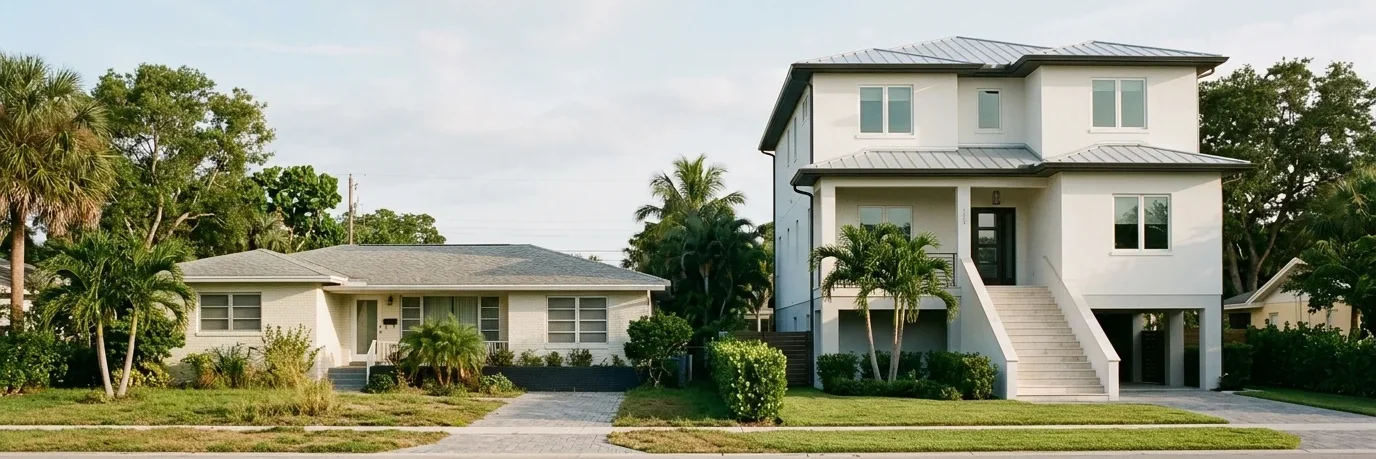
A Naples home’s first floor elevation is how high its lowest floor sits, and what matters is how that compares with the Base Flood Elevation FEMA maps for high-risk flood zones. You find both on the home’s elevation certificate. That comparison, together with the flood zone, shapes flood insurance, what a lender requires, what you can remodel or rebuild, and how the next buyer will see the house.
I am Joe Belz, a Broker Associate at Compass and the lead agent of Joe Belz + Apex Team. “What is the first floor elevation of this home?” and “Are insurance costs still rising?” are two of the questions buyers ask me. Here are the answers, with official sources you can check yourself.
I moved to Naples in 1980 and have been in the Naples real estate market since 1990. Much of this can be checked before you write an offer, if you know where to look.
Flood zones on the FEMA map: AE, VE and X
FEMA’s Flood Insurance Rate Maps divide a community into flood zones. The City of Naples states that its 2024 maps, effective February 8, 2024, are in effect for construction and insurance purposes, replacing the 2012 maps, and it publishes plain definitions of each zone.
| Zone | City of Naples definition, in brief | What it means for a buyer |
|---|---|---|
| AE | Subject to the 1% annual chance flood; Base Flood Elevations determined; mandatory purchase and floodplain standards apply | A federally backed mortgage requires flood insurance; new work must meet elevation rules |
| VE | Coastal high hazard area subject to the 1% annual chance flood, where wave action or high-velocity water can cause structural damage; waves of 3 feet or greater | FEMA describes these as coastal areas with added wind and wave hazards; building requirements are more demanding |
| AH | 1% annual chance shallow flooding, usually ponding, 1 to 3 feet deep; Base Flood Elevations determined | Treated as high risk for lending and building |
| X (shaded) | Subject to the 0.2% annual chance flood with average depths under 1 foot; insurance not required but recommended | Outside the high-risk area on the map, not outside flood risk |
| X (unshaded) | Outside the 0.2% annual chance flood; insurance not required but recommended | Lower mapped risk; flood coverage is still a decision |
FEMA calls the A and V zones Special Flood Hazard Areas: the area that would be inundated by the flood having a 1 percent chance of being equaled or exceeded in any given year, often called the “100-year flood.” That sounds rare. A 1 percent chance every year is not rare over a long ownership.
A zone is a map designation, not a promise. The City of Naples says so on its floodplain page: “Flooding can occur anywhere, anytime, and just because it has not happened yet does not mean it can’t or won’t happen sometime in the near future.” The City also describes itself as lying close to sea level, fronted by the Gulf, with Moorings Bay and Naples Bay winding through a system of canals. That is why elevation matters here.
Base flood elevation and first floor elevation
FEMA defines the Base Flood Elevation (BFE) as the elevation of surface water resulting from a flood that has a 1 percent chance of equaling or exceeding that level in any given year. In AE and VE zones, the map assigns a BFE.
The first floor elevation is the other half of the comparison. FEMA’s FloodSmart site says an elevation certificate shows “how high a building is compared to how high local floodwaters are expected to get,” including the First Floor Height, the height of the lowest floor above the ground. FEMA’s reasoning is simple: water flows downward, so the higher the first floor, the less likely the home is to suffer flood damage.
So the real question is where this floor sits relative to that line. Two homes in the same zone on the same street can sit very differently against it.
How to look up a Naples property yourself
You do not need to take anyone’s word for a flood zone. These are the official tools.
Where to look up flood zone and elevation information
- FEMA Flood Map Service Center, msc.fema.gov, which FEMA calls the official public source for flood hazard information for the National Flood Insurance Program. Search by address.
- City of Naples. The City’s Flood Zone Maps page links to its interactive web tool; enter an address to view your area. The Floodplain Coordinator answers flood zone questions and provides elevation certificates if on file, at 239-213-5039.
- Collier County. For unincorporated Collier County, the Floodplain Management page offers the 2024 effective flood map with an elevation certificate search. The Flood Information Hotline is (239) 252-2942, and staff can provide a flood determination.
Know which government you are dealing with. Some Naples addresses are inside the City and some are in unincorporated Collier County, and the permit office, floodplain manager and records differ on each side of that line. The City’s guidance is to use the county or FEMA map for properties outside the city limits.
Both governments add a caution. The City states that its online flood zone and elevation certificate information is a public service, subject to change, and that before buying or building it should be confirmed with an official flood zone determination by a Florida licensed engineer, architect or surveyor. The County calls its online map a simplified version of the flood map, for finding an approximate flood zone. Maps change too. FEMA issued preliminary maps for Collier County and the City of Naples on March 20, 2025. They are not in effect. Collier County says a 90-day appeal period began August 19, 2026, and targets summer 2027 for the new map to take effect, a date subject to change. A lookup is where you start, not where you finish.
The elevation certificate: what it is and where to get one
FEMA explains that a community’s permit file must hold an official record showing that new buildings and substantial improvements in Special Flood Hazard Areas are properly elevated, and that it encourages communities to use FEMA’s Elevation Certificate, since owners can also use it to obtain flood insurance. Collier County calls it an official record that identifies the elevations of a structure and demonstrates compliance with NFIP requirements and the County’s floodplain ordinance.
- Ask the seller. Many owners have one from construction, a remodel or an insurance application.
- Ask the local floodplain manager. FloodSmart notes your home may have one on file with your community. The City’s Floodplain Coordinator provides them if on file, and Collier County says to call its Flood Info Hotline to find out whether it has one for your structure.
- If none exists, order one from a land surveyor, engineer or architect, ideally before your inspection period ends.
Check the date. An older certificate may reference an older map, and a house that has been remodeled may no longer match it. Collier County notes you may need a new certificate or a policy update after renovations.
How first floor elevation affects insurance and resale
Flood pricing under Risk Rating 2.0
FEMA’s current NFIP pricing approach, Risk Rating 2.0, was phased in from October 1, 2021 and fully implemented April 1, 2023. In plain language, FEMA moved away from pricing mostly on a property’s elevation within a map zone and now uses more variables: flood frequency, several flood types (river overflow, storm surge, coastal erosion and heavy rainfall), distance to a water source, and property characteristics such as elevation and the cost to rebuild.
Three details from FEMA matter to buyers. The pricing approach does not use flood zones to determine flood risk, though the maps still drive the mandatory purchase requirement and building rules. Existing statutory limits require that most rates not increase more than 18 percent per year. And a policyholder can transfer a discount to a new owner by assigning the flood policy when the property sells, so ask about the seller’s policy before you close. As for elevation, FloodSmart says elevation certificates don’t set your rate but can identify discounts.
Remodeling, rebuilding and resale
Under City of Naples rules, if a home in a Special Flood Hazard Area sits below the required flood elevation and an improvement costs 50 percent or more of the structure’s pre-improvement market value, it is a “substantial improvement,” and the building must be brought into compliance, including elevating it to or above the base flood elevation. The same 50 percent test applies to repairing substantial damage. The City also says substantial improvements must at a minimum comply with the flood provisions of the current Florida Building Code, whose residential provisions set the lowest floor at the BFE plus 1 foot, or the design flood elevation if that is higher. The City uses the assessed value of the structure recorded by the Collier County Property Appraiser, excluding land and pool. Collier County applies the same FEMA-based 50 percent rule.
That is one reason a lower, older house can end up priced as a lot, and I cover that in buying a teardown lot in Olde Naples, the Moorings or Coquina Sands. If you plan to keep and renovate, the 50 percent line is a budget ceiling to understand before you design anything.
Have a specific Naples address in mind?
Send it to me. I will pull what I can find on the flood zone and elevation certificate and walk you through what I would ask next.
Contact JoeFlood and wind: two exposures, usually two policies
- Flood. FEMA states that most homeowners insurance does not cover flood damage, and Florida’s seller flood disclosure form tells buyers the same. Flood coverage comes from an NFIP policy, a private flood policy, or both.
- Wind. Hurricane wind is typically covered in the homeowners policy or a separate wind-only policy, priced partly on how the house is built.
Storm surge is flood. A hurricane can damage one house mainly with wind and the next mainly with water, and those claims go to different policies. Get both quotes early.
NFIP basics, private flood and excess flood
The City of Naples and Collier County both participate in FEMA’s National Flood Insurance Program. The basics, from FloodSmart, FEMA and the City:
- Building coverage for a home is capped at $250,000 and contents at $100,000, purchased separately with separate deductibles.
- There is typically a 30-day waiting period before a new policy takes effect, with exceptions, including coverage required for a loan.
- Flood insurance is mandatory in a Special Flood Hazard Area with a federally backed mortgage.
- FEMA’s list effective October 1, 2026 shows the City of Naples and Collier County each at Community Rating System Class 5, which carries a 25 percent discount on eligible NFIP policies.
For homes in the range I work in, the $250,000 building limit is the headline. The cost to rebuild many of these homes can exceed it, so owners often look at private flood insurance, excess flood coverage above an NFIP policy, or both. Section 627.715 of the Florida Statutes allows authorized insurers to write both. Premiums depend on the house, the coverage and the carrier, so get a real flood quote before your inspection period ends.
Citizens and what regulators publish on rates
Citizens Property Insurance Corporation was created by the Florida Legislature in 2002 as a not-for-profit alternative insurer for property owners who cannot find coverage in the private market. Its rates are set through the Florida Office of Insurance Regulation (OIR). On “are insurance costs still rising?”, 2026 brought real numbers:
- On January 13, 2026, OIR published the Governor’s announcement of a statewide average reduction of 8.7 percent for Citizens policyholders under approved rates. The release said dozens of homeowners and auto insurers have filed for rate decreases.
- On March 4, 2026, Citizens announced its homeowners multiperil rates would drop an average of 8.8 percent and wind-only rates 5.5 percent, effective July 1 for new policies and at renewal for existing ones.
Two cautions. An average is not your premium. And for many homes I sell, Citizens is not an option: under section 627.351 of the Florida Statutes, a structure with a dwelling replacement cost of $700,000 or more is generally not eligible, and the statute generally requires Citizens to make flood insurance a condition of its personal residential coverage. For most luxury homes, the regulator’s numbers show the direction of the market, and the private market quote is the one that matters.
In my view, insurance availability and cost were a major concern in 2024, and that has turned around. Get real quotes on the real house rather than deciding from a headline.
The wind mitigation inspection and its credits
For wind, the key document is the Uniform Mitigation Verification Inspection Form, OIR-B1-1802, completed by an authorized inspector. Section 627.0629 of the Florida Statutes ties insurance discounts and deductible reductions to construction features shown to reduce windstorm damage.
- What gets inspected. Citizens lists the structure and materials, roof shape, covering and connections, walls, doors, windows and skylights, shutters or panels, and the attic. Without attic access, a home may miss credits for roof-to-wall attachment, roof-deck attachment and secondary water resistance.
- The form changed. OIR updated OIR-B1-1802 effective April 1, 2026. Citizens says inspections from that date must use the new form, that the changes do not alter the credits available at this time, and that it still accepts the prior version if it was completed within five years before that date and the structure has not changed.
- How long it lasts. OIR states the form is valid for up to five years if no material changes are made to the structure and no inaccuracies are found.
On a resale home, ask for the seller’s wind mitigation report along with the elevation certificate. If it is more than five years old, or the roof or openings have changed, order a new inspection before closing so the quote reflects the house as it is.
What Ian, Helene and Milton did along this coast
The National Hurricane Center’s official Tropical Cyclone Reports record the following.
- Hurricane Ian, 2022. Ian made landfall on Cayo Costa on September 28, 2022 at category 4 intensity and produced a catastrophic storm surge along the southwest Florida coast, including Naples Bay. The NHC reports maximum inundation of 6 to 9 feet above ground level in Naples, and that in Collier County 33 buildings were destroyed and over 3,500 sustained major damage.
- Hurricane Helene, 2024. Helene made landfall far to the north in the Florida Big Bend, yet the NHC reports surge and wave impacts extending as far south as Naples, with maximum inundation of 2 to 4 feet above ground level in areas such as Naples, Marco Island and Everglades City.
- Hurricane Milton, 2024. Milton made landfall on Siesta Key as a category 3 hurricane. The NHC reports maximum surge inundation of 3 to 5 feet above ground level from Bonita Beach through Marco Island, with the Naples Bay tide gauge at 5.08 feet above Mean Higher High Water.
The lesson is not about any one street: a storm that makes landfall well away from Naples can still push water into it.
“Did this home get water?” and how it connects to elevation
This question belongs with the elevation question. Elevation tells you how a house sits against the mapped flood. History tells you what actually happened to it.
Florida now requires a written answer. Under section 689.302 of the Florida Statutes, a seller of residential property must give the buyer a flood disclosure at or before signing the sales contract, stating whether they know of flooding that damaged the property during their ownership, whether they filed a flood insurance claim, including with the NFIP, and whether they received flood assistance, including from FEMA. The disclosure covers only the seller’s ownership and knowledge, so read it together with:
- the elevation certificate, to see where the living floor sits against the BFE;
- the permit history, for post-storm repair permits or a substantial damage determination;
- the inspection, looking for signs of past water at the lowest floor, the garage and the mechanical equipment;
- the seller’s flood and wind policies, and whether the flood policy can be assigned to you.
Together they give a much better answer than a yes or no at a showing. The full checklist, including association finances, special assessments and generators, is in Naples home buyer due diligence: questions to ask before you make an offer.
What elevated new construction changes
New construction in a Special Flood Hazard Area has to meet today’s rules. The City of Naples says new construction and substantial improvements must at minimum comply with the flood provisions of the current Florida Building Code. For homes, those provisions set the lowest floor at the BFE plus 1 foot, or the design flood elevation if that is higher. In Zone X, section 16-144 of the City’s Floodplain Management Code says the flood elevation must be equivalent to 18 inches above the average crown of the adjacent roads. Collier County requires new machinery such as air conditioners and generators to be elevated to the BFE plus one foot. That is why a new home can sit noticeably higher than the older home next door.
A new, elevated home arrives with a current elevation certificate and current construction. It does not mean a new home can’t take water. More in new construction in Naples west of 41.
What to do on a showing
- Before you go, look up the flood zone and ask the listing agent for the elevation certificate, the wind mitigation report and the seller’s flood disclosure.
- At the house, look at where the living floor sits relative to the street, where the air conditioning and any generator sit, and the seawall and dock if it is on the water.
- Ask directly: did this home get water in Ian, Helene or Milton, what was repaired, and was it permitted?
- If the answers are thin, order what is missing inside the inspection period, and have flood and wind quotes before it ends.
My building background helps here. I started in this business in new construction, and my development company, Belz Properties, developed about 20 homes in Olde Naples, Coquina Sands and the Moorings, so I can give insights on construction costs, zoning and permitting.
In canal and bay neighborhoods such as Royal Harbor, Aqualane Shores and Port Royal, homes of very different ages and designs can sit side by side, so each house stands on its own facts. The on the water page is a good start if boating access is part of your search.
Frequently asked questions
Look at the home’s elevation certificate, a FEMA form completed by a licensed surveyor, engineer or architect. Ask the seller first. Inside the City of Naples, the City’s Floodplain Coordinator provides elevation certificates if one is on file. In unincorporated Collier County, the County’s flood map has an elevation certificate search and the Flood Information Hotline is (239) 252-2942. If none exists, hire a surveyor to prepare one.
The City of Naples defines Zone AE as an area subject to inundation by the 1 percent annual chance flood, with Base Flood Elevations determined. Mandatory flood insurance purchase requirements and floodplain management standards apply, so a federally backed mortgage will require flood insurance and new construction must meet elevation rules.
Both are high-risk Special Flood Hazard Areas with Base Flood Elevations. The City of Naples describes VE as a coastal high hazard area where wave action or high-velocity water can cause structural damage, with waves of 3 feet or greater. Building requirements in VE are more demanding; the Florida Building Code, for example, measures the required height there to the bottom of the lowest horizontal structural member rather than to the floor.
Generally, no. FEMA states that most homeowners insurance does not cover flood damage, and Florida’s seller flood disclosure under section 689.302 of the Florida Statutes tells buyers the same. Flood is a separate policy, from the National Flood Insurance Program or a private insurer, while wind is usually part of the homeowners policy or a wind-only policy.
FEMA’s FloodSmart site states that NFIP building coverage for a home goes up to $250,000 and contents coverage up to $100,000, purchased separately with separate deductibles. Owners whose home would cost more to rebuild often add private or excess flood coverage, which section 627.715 of the Florida Statutes allows authorized insurers to write.
FEMA states there is typically a 30-day waiting period before an NFIP policy takes effect, with exceptions, including coverage required in connection with a loan. Line up flood coverage with your agent and lender well before closing.
Florida requires a seller of residential property to give the buyer a flood disclosure at or before signing the sales contract. Under section 689.302 of the Florida Statutes, the seller states whether they know of flood damage during their ownership, filed a flood insurance claim, or received flood assistance such as from FEMA. Read it with the elevation certificate, the inspection and the permit history.
On average, yes. A January 13, 2026 release published by the Florida Office of Insurance Regulation reported a statewide average reduction of 8.7 percent for Citizens policyholders, and Citizens said on March 4, 2026 that its homeowners multiperil rates would fall an average of 8.8 percent. Individual premiums vary, and homes with a dwelling replacement cost of $700,000 or more are generally not eligible for Citizens.
Related resources
- Naples home buyer due diligence: questions to ask before you make an offer
- New construction in Naples west of 41
- Buying a teardown lot in Olde Naples, the Moorings or Coquina Sands
- What people get wrong about Naples real estate
- Naples homes on the water
- Royal Harbor, Aqualane Shores and Port Royal
- Buying with Joe Belz + Apex Team
Want the flood and insurance picture before you make an offer?
Tell me the address or the neighborhood. I am happy to talk through the flood zone, the elevation certificate and the insurance questions with you.
Contact JoeSources
- FEMA: Flood Zones glossary; NFIP terminology index; Elevation Certificate glossary; Flood Insurance; Risk Rating 2.0; Community Rating System eligible communities, October 1, 2026, fema.gov. FEMA FloodSmart, coverage and elevation certificates, floodsmart.gov. FEMA Flood Map Service Center, msc.fema.gov
- City of Naples Building Department: Building; Floodplain Information; Flood Zone Maps; Flood Insurance; Development in the Floodplain; Staff Directory, naplesgov.com
- Collier County: Floodplain Management; March 2026 Floodplain Protection Newsletter; Proposed Flood Insurance Rate Map notice, August 19, 2026, collier.gov
- FEMA, Proposed Flood Hazard Determinations, Federal Register, December 18, 2025, federalregister.gov
- Florida Statutes (2026), sections 627.0629, 627.351, 627.715 and 689.302, flsenate.gov
- Florida Division of Emergency Management, Flood Resistant Provisions in the 8th Edition Florida Building Code (2023), sections R322.2.1 and R322.3.2, floridadisaster.org
- Florida Office of Insurance Regulation: Wind Mitigation Resources and January 13, 2026 release, floir.gov
- Citizens Property Insurance Corporation: March 4, 2026 release; Your Wind Inspection; March 19, 2026 bulletin, citizensfla.com
- National Hurricane Center Tropical Cyclone Reports: Hurricane Ian (AL092022), Hurricane Helene (AL092024) and Hurricane Milton (AL142024), nhc.noaa.gov
- All sources accessed October 30, 2026
Maps, rates, forms and rules are current as of the dates stated and can change. This guide is general information. It is not legal, insurance, engineering, tax or financial advice, and it is not a flood zone determination or a statement about the flood risk of any property. Confirm a property’s flood zone and elevation with the City of Naples or Collier County and a Florida licensed surveyor, engineer or architect, and get coverage advice from a licensed insurance agent.
Social Cookies
Social Cookies are used to enable you to share pages and content you find interesting throughout the website through third-party social networking or other websites (including, potentially for advertising purposes related to social networking).