

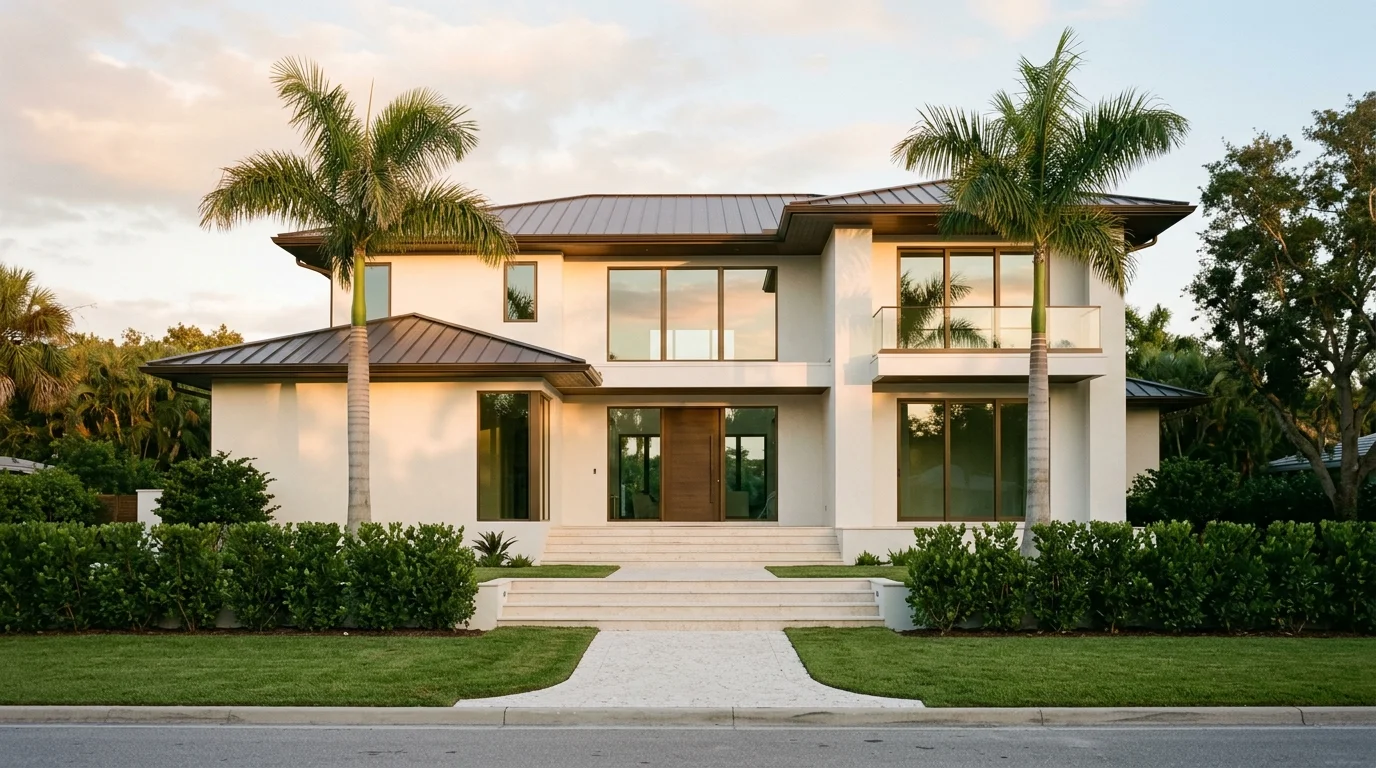
New construction in Naples west of 41 comes in three forms: a completed or spec home a builder has already finished, a home still under construction, or a lot you buy so you can design and build your own. A custom home runs on a 2 to 3 year timeframe to buy, design and build, and every path runs through the same rules: which government permits the house, how high the lowest floor has to sit above the flood elevation and, for work seaward of the state’s Coastal Construction Control Line, a state coastal permit.
I am Joe Belz, a Broker Associate at Compass and founder of Joe Belz + Apex Team. New construction is how I got started in the business. Two of my recent new-construction sales: a home in the Moorings that closed for $18.3 million in January 2026, where I represented the buyer, and a home in Olde Naples that closed for $15.1 million in July 2026, where I was on the listing side.
What “west of 41” means in Naples
US 41, the Tamiami Trail, is the dividing line locals use. “West of 41” is shorthand for the Gulf-side neighborhoods between the highway and the water: Olde Naples, Aqualane Shores, Port Royal, the Moorings, Coquina Sands and Park Shore. It is where I focus, and single-family homes from $5 million to $20 million west of 41 are my target.
The housing stock here is turning over: original homes on generous lots sit next to houses finished last year. Some lots are on canals and bays with boat access, some front the Gulf, and others are a short walk from the beach or Fifth Avenue South. Each of those changes what you can build and what it costs. Figuring out what part of town you want to live in is critical. The On the Water page covers the waterfront side.
All six of these neighborhoods are inside the City of Naples, so new homes there are permitted by the City, not Collier County.
My background in new construction
New construction is how I got started in the business, and I have been in the Naples market since 1990. I ran sales and marketing in Naples for Centex Homes, and I was in charge of about 10 neighborhoods across Naples, Bonita Springs, Estero and Fort Myers. I moved to Dallas, where I went from sales management to Area Manager, overseeing sales and construction in an area doing 300 homes per year.
I moved back to Naples to handle sales for Sussex Homes and Naples Redevelopment, on projects in Olde Cypress, Olde Naples, Coquina Sands, Pelican Landing and Bay Forest. Through Belz Properties, my development company, I developed about 20 homes between Olde Naples, Coquina Sands and the Moorings, and I have done about 80 deals in various capacities with one Naples builder. I also represented SoCe Flats, a hotel condo project in Olde Naples, which sold out in 2021. I joined Compass in 2017.
My years of being a developer allow me to give people insights on construction costs for new homes or remodeling, zoning and permitting. My profile, Joe Belz, Naples Real Estate Broker at Compass, has the full career, and builder and developer services covers my work with builders.
New-construction sales in my target range
| Neighborhood | Sale price | Closed |
|---|---|---|
| Olde Naples | $15.1 million | July 2026 |
| The Moorings | $18.3 million | January 2026 |
| Park Shore | $7.0 million | October 2025 |
| Aqualane Shores | $7.4 million | July 2021 |
| Aqualane Shores | $8.3 million | May 2021 |
I represented the buyer on the Moorings home and was on the listing side of the Olde Naples home. From January 2018 through July 2026, the MLS records of my new-construction sales show more than 25 closings, counting the SoCe Flats residences, including homes in Olde Naples, Coquina Sands, the Moorings, Aqualane Shores and Park Shore.
My other closed sales west of 41 include $12.0 million in Aqualane Shores in January 2026, $9.25 million in Coquina Sands in December 2025 and $9.075 million in Port Royal in February 2021.
The three paths to a new home
Each path asks something different of you, so it helps to choose the path before you choose the house.
| Path | What you get | What it asks of you | Where the risk sits |
|---|---|---|---|
| Completed or spec home | A finished house you can walk, inspect and move into on a normal closing timeline | Accepting the builder’s design and finish decisions | Workmanship you evaluate after the fact; the warranty and the builder behind it |
| Home under construction | A house already designed and permitted, sometimes with finish selections still open | Patience through the rest of the build, and close attention to the contract | Completion date, deposit protection, change-order pricing and what “complete” means at closing |
| Lot and custom build | Every decision: the site, the architect, the builder, the plan and the finishes | A 2 to 3 year timeframe, and a great deal of your time and judgment | Lot conditions, cost growth over a long schedule, permitting and flood rules, and builder selection |
Buying a completed new home or spec home
A spec home is one a builder starts without a buyer. It is the fastest way into new construction west of 41 and the only path where you see exactly what you are paying for. Ask for the permit history, the final elevation certificate and the warranty in writing, and get an independent inspection anyway. New is not the same as inspected by someone working for you.
Buying a home under construction
Buying mid-build gets you in sooner than starting from a lot, and sometimes gives you a say in finishes. The contract does the work here: how the deposit is held, what the completion date commits to, how change orders are priced, and what “complete” means at closing. The Florida deposit rules below are narrower than many buyers assume.
Buying a lot and building custom
Building west of 41 usually starts with an older house that will come down. The lot drives everything that follows: flood zone, width, frontage, seawall and dock, and jurisdiction. Read Buying a Teardown Lot in Olde Naples, the Moorings or Coquina Sands before you offer on anything you plan to replace.
The realistic timeline: 2 to 3 years, in stages
The clock starts the day you commit to the lot. Any project can run faster or slower, and the stages overlap, so their pace depends on the lot and the house.
| Stage | What happens | What sets the pace |
|---|---|---|
| 1. Lot | Contract the lot; survey; confirm flood zone and jurisdiction; check seawall, dock and permits | Inventory where you want to be, and your due diligence |
| 2. Design | Architect and engineer design around setbacks, flood elevation and your program; builder pricing runs alongside | Your decisions, plan changes and the architect’s workload |
| 3. Permitting | Demolition and building permits, floodplain review, and a state coastal permit if the work is seaward of the Coastal Construction Control Line | A complete submittal, review comments, and any state permit |
| 4. Construction | Demolition, foundation, shell, systems, finishes and site work, with inspections | Builder capacity, weather, material lead times and change orders |
| 5. Closeout | Final inspections, final elevation certificate, certificate of occupancy, punch list | How clean the build was |
One detail buyers rarely hear: the City of Naples states that its Floodplain Coordinator reviews building spot and final elevation certificates, so the elevation is checked during construction and again at the end. Design has to get it right the first time.
Why I think now is the time to start
As of September 2026, I am showing my builder and developer clients how very few homes are under construction, as many are sitting on inventory and cannot buy more until it sells. With a 2-3 year timeframe to buy, design and build a home, I think now is the time to start, due to the lack of competition.
For a buyer, that read cuts two ways: finished homes builders are carrying may be available now, and a custom project started today may compete with fewer others. Either way, use local data, not national, for the neighborhood and kind of home you want.
Weighing a spec home against building your own?
Share the neighborhood and the kind of home you have in mind, and compare what each path would look like on a real lot.
Contact JoeCity of Naples or Collier County: who permits your home
Confirm jurisdiction first, because it decides who reviews your plans and which local floodplain rules apply on top of the state code.
- City of Naples. Covers the six neighborhoods above. Building Department: 295 Riverside Circle, 239-213-5020. Floodplain Coordinator: 239-213-5039. The City states that almost all permitted development in the City requires a floodplain review, and it runs a public portal for electronic permitting and permit search.
- Collier County. The City’s flood map page sends owners of properties outside the city limits to the county or FEMA flood map. Collier County states that all development in its Special Flood Hazard Areas must be reviewed by the County; its Flood Information Hotline is (239) 252-2942.
A Naples mailing address does not tell you which one you are in. Confirm it for the parcel with the City or County, and check the Collier County Property Appraiser record, before you design anything.
Flood elevation rules for new homes
Flood elevation shapes a new home west of 41: the first floor, the foundation, the entry and often the height of the house. First Floor Elevation, Flood Zones and Insurance for Naples Homes goes deeper. Here is the framework.
The terms
FEMA defines the Base Flood Elevation (BFE) as the elevation of surface water from a flood with a 1 percent chance of equaling or exceeding that level in any given year, shown on the Flood Insurance Rate Map. In the City of Naples’ descriptions, Zones AE and AH are Special Flood Hazard Areas with Base Flood Elevations determined; Zone VE is a coastal high hazard area where wave action or high-velocity water can cause structural damage; and in Zone X the City states flood insurance is not required but recommended.
What a new home has to meet
The Florida Building Code sets the baseline. Under section R322.2.1 of the current 8th Edition (2023) residential code, the lowest floor of a home in a flood hazard area, other than a Coastal A Zone, must be at or above the Base Flood Elevation plus 1 foot, or the design flood elevation, whichever is higher. In coastal high hazard areas such as Zone VE, and in Coastal A Zones, section R322.3.2 applies that same elevation to the bottom of the lowest horizontal structural members supporting the lowest floor. The City of Naples Code places the inland limit of the Coastal A Zone at the limit of moderate wave action shown on the Flood Insurance Rate Map.
Collier County describes the BFE plus 1 foot standard as a requirement of the Florida Building Code, and its Floodplain Management Ordinance adds that the lowest living floor of a new home must also be 18 inches above the crown of the road if paved, or 24 inches if unpaved. The County gives these as general guidelines for AE, AH and A flood zones.
The City of Naples states that all new construction and substantial improvements must at a minimum comply with the flood provisions in the current Florida Building Code, and that floodproofing below the BFE is not permitted for residential buildings under the National Flood Insurance Program. Section 16-144 of the City’s Floodplain Management Code, last amended in September 2025, says the flood elevation in Zone X must be equivalent to 18 inches above the elevation of the average crown of the adjacent roads abutting the property. Local rules can exceed the state minimum, so City floodplain staff and your design team set the actual number for your lot.
The code itself is about to change. The Florida Building Commission’s October 2026 workplan lists December 31, 2026 as the effective date of the 9th Edition (2026) Florida Building Code. On a project still in design, ask your architect and the permitting office which edition will apply to your application.
The flood maps are changing too
The City of Naples states that its 2024 Flood Insurance Rate Maps are in effect for construction and insurance purposes, and Collier County lists its 2024 map as current and effective. A revision covering parts of the county is in process. Collier County says a 90-day appeal period on its proposed Flood Insurance Rate Map began August 19, 2026, with a target of summer 2027 for the new map to take effect, a date it says is subject to change. On a 2 to 3 year project, check both the current map and the proposed one. The FEMA Flood Map Service Center shows both.
No lot is flood-proof, and a map is only a starting point
The City of Naples puts it plainly: flooding can occur anywhere, anytime, and just because it has not happened yet does not mean it can’t or won’t happen. The City advises confirming flood information before purchase or construction with an official flood zone determination from a Florida licensed engineer, architect or surveyor. Look up any address on the City or County flood map or the FEMA Flood Map Service Center as a starting point.
The 50 percent rule and older homes
The City of Naples defines a substantial improvement as work whose cost equals or exceeds 50 percent of the market value of the structure before the improvement. The City states that a substantially improved building must be brought into compliance with its flood regulations, including elevating it to or above the base flood elevation, and that substantial improvements must at a minimum comply with the Florida Building Code flood provisions. The City says it uses the structure value recorded by the Collier County Property Appraiser, which excludes the land and pool, and its Floodplain Management Code describes that assessed value as adjusted by a factor the Property Appraiser provides. An owner who disagrees may submit an appraisal from a State of Florida licensed appraiser, dated within six months of permit submittal.
On a house below today’s required elevation, a serious renovation can reach the 50 percent threshold quickly, which can tip the decision toward replacing the house rather than remodeling it. Price both options before you fall for a floor plan.
Gulf-front lots: the Coastal Construction Control Line
Gulf-front parcels can carry a state layer on top of the local permit. Under Florida Statutes section 161.053, the Florida Department of Environmental Protection sets Coastal Construction Control Lines county by county to mark the part of the beach-dune system subject to severe fluctuations based on a 100-year storm surge, storm waves or other predictable weather conditions. The statute provides for a Department permit to construct seaward of that line, except for activities the Department has delegated to a local government.
The Department states that siting and design standards in that zone may be more stringent than those in the rest of the coastal building zone. The statute also generally bars the Department, subject to exceptions it lists, from permitting most new structures in a location projected to be seaward of the seasonal high-water line within 30 years. On a beach lot, locate the line with the Department’s CCCL program tools and talk to a coastal engineer before you set a budget or schedule.
Florida buyer protections on new construction
Two Florida statutes matter here. How either applies to your contract is a question for a Florida attorney.
Deposits: Florida Statutes section 501.1375
- It covers a “building contractor” or “developer” of one-family or two-family homes, but not a person who sells or constructs less than 10 units per year statewide. A small custom builder may fall outside it, so do not assume it covers your contract.
- Where it applies, the builder must notify you that deposits up to 10 percent of the purchase price will be held in escrow (with a bank, trust company, Florida Bar attorney, licensed Florida real estate broker or title insurer, among others) unless you waive that right in writing, and the contract must carry a conspicuous notice of that right.
- To use escrowed funds for construction, the builder must notify you and obtain a surety bond payable to you, if one is readily available; the statute sets out alternatives if not.
- Deposits made to a licensed real estate broker are handled under Chapter 475 instead.
Construction defects: Florida Statutes Chapter 558
- Before filing a lawsuit over a construction defect, the owner must serve a written notice of claim on the contractor, subcontractor, supplier or design professional at least 60 days before filing (120 days for an association representing more than 20 parcels).
- The notice must describe each defect and its location in reasonable detail. The party served may inspect within 30 days and must respond in writing within 45 days: an offer to repair, to pay, a combination, a dispute, or a statement that the insurer will decide on payment.
- Unless the parties agree that Chapter 558 does not apply, a written contract between an owner and a contractor made after October 1, 2009 must contain substantially this notice: “ANY CLAIMS FOR CONSTRUCTION DEFECTS ARE SUBJECT TO THE NOTICE AND CURE PROVISIONS OF CHAPTER 558, FLORIDA STATUTES.”
- A notice of claim does not pause any statute of repose period under Chapter 95, so do not wait on a defect.
What drives the cost of building west of 41
A cost per square foot without the plan behind it says very little. The better question is where the money goes:
- The lot. Price, width, frontage (Gulf, bay, canal or interior), seawall and dock condition, and demolition.
- Elevation and foundation. The flood zone and required elevation set how high the house sits and what foundation the engineer designs.
- Design complexity. Rooflines, spans and glass walls cost more to engineer and build than simple forms.
- Finishes and allowances. Where budgets tend to move after the contract is signed.
- Outdoor program. Pools, hardscape and landscaping are real line items.
- Time. Over 2 to 3 years, carrying costs and price changes add up.
- Soft costs. Architecture, engineering, surveys, permits and any state coastal permit.
How to evaluate a builder
A builder is a long relationship and the biggest single decision after the lot. These checks apply to any builder you consider.
Builder checklist
- Look up the company and its qualifying individual on the Florida Department of Business and Professional Regulation’s license search at myfloridalicense.com. Check status and type: under Florida Statutes section 489.105, a residential contractor, for example, is limited to homes of no more than two habitable stories above no more than one uninhabitable story.
- Review their permit history with the City or County, and visit homes they have finished.
- Get the warranty in writing: coverage, length, who stands behind it, and how claims work.
- Read the deposit and draw terms against section 501.1375.
- Read the change-order, allowance and completion-date terms, look for the Chapter 558 notice, and have a Florida attorney review the whole agreement.
Naples Home Buyer Due Diligence: Questions to Ask Before You Make an Offer covers the questions buyers ask most, from “Did this home get water?” to first floor elevation.
Selling an older home to a buyer who plans to build
Many older homes west of 41 sit on lots a buyer sees as a building site. That changes how you prepare and price.
- Know what you are selling. For a builder-buyer the value is the land: location, width, frontage, water access, seawall and dock. Updates to the house may add little.
- Hold off on renovating until you know whether the likely buyer will keep the house.
- Have the paperwork ready: a current survey, any elevation certificate on file (the City of Naples provides those it has), seawall and dock permits, and the permit history.
- Price for both buyers. A home can appeal to someone who will live in it and someone who will replace it.
- Expect due diligence. A builder-buyer will want time to confirm the flood zone, jurisdiction and what can be built. Plan for it in the contract.
Selling a Luxury Home in Olde Naples, the Moorings or Park Shore covers the full seller side. For a starting number, request a home value, or read the Sellers page.
If a golf club is part of the plan
Most of my clients are golfers, but the neighborhoods where I have done the most business are not golf communities. Live in the best locations and drive to a private golf club is what they do. The Moorings has a short golf course, but for most of these buyers the club and the lot are two separate decisions, and 5 year + waitlists are common. We help people navigate which club and then where to live.
If you are building west of 41 and want to join a club, start with Naples Golf Clubs Compared: Initiation Fees, Dues and Waitlists (2026) and the Apex Team Golf Club Quiz. Olde Florida Golf Club, where I have been a member since May 2021, is a golf club with no homes on the course, so where you live is a separate choice.
Relocating? See Moving to Naples from Chicago and What People Get Wrong About Naples Real Estate. The people you would work with are introduced in Joe Belz + Apex Team, Naples Real Estate Team at Compass.
Frequently asked questions
In Joe Belz’s view, plan on a 2 to 3 year timeframe to buy a lot, design and build a custom home west of US 41 in Naples, across the lot purchase, design, permitting, construction and closeout. Buying a completed spec home is faster, and buying a home under construction sits in between.
Yes. Joe Belz started in the business in new construction. His recent new-construction sales include a home in the Moorings that closed for $18.3 million in January 2026, where he represented the buyer, and a home in Olde Naples that closed for $15.1 million in July 2026, where he was on the listing side. He also ran sales and marketing in Naples for Centex Homes.
Yes. Olde Naples is inside the City of Naples, along with Aqualane Shores, Port Royal, the Moorings, Coquina Sands and Park Shore, so homes there are permitted by the City of Naples. A Naples mailing address alone does not put a property inside City limits, so confirm the jurisdiction for any specific parcel.
It depends on the flood zone. Under the current Florida Building Code, the lowest floor of a home in a flood hazard area, other than a Coastal A Zone, must be at or above the Base Flood Elevation plus 1 foot, or the design flood elevation if that is higher. In Zone VE and Coastal A Zones the same elevation applies to the bottom of the lowest horizontal structural members supporting the lowest floor. The City of Naples states that new construction must at a minimum meet the Florida Building Code flood provisions, and section 16-144 of its Code says the flood elevation in Zone X must be equivalent to 18 inches above the average crown of the adjacent roads. Collier County adds a minimum height above the crown of the road for homes in the Special Flood Hazard Areas it reviews. Confirm the requirement for a specific lot with floodplain staff and a Florida licensed engineer, architect or surveyor.
Yes, in parts of the county. Collier County says a 90-day appeal period on its proposed Flood Insurance Rate Map began August 19, 2026, with a target of summer 2027 for the new map to take effect, a date it says is subject to change. The 2024 maps remain in effect until then.
If the work is seaward of the Coastal Construction Control Line, Florida Statutes section 161.053 provides for a permit from the Florida Department of Environmental Protection, unless the Department has delegated permitting for that activity to the local government, in addition to local building permits. You can locate the line through the Department’s Coastal Construction Control Line program and map tools.
Under Florida Statutes section 501.1375, a building contractor or developer who sells or builds 10 or more one-family or two-family homes a year statewide must tell the buyer that deposits up to 10 percent of the purchase price will be held in escrow unless the buyer waives that right in writing. Smaller builders fall outside that definition, so read the deposit terms in every contract.
Florida Statutes Chapter 558 sets a notice and opportunity to repair process. At least 60 days before filing a lawsuit over a construction defect, the owner must serve a written notice of claim describing each defect in reasonable detail. The contractor may inspect and must respond in writing, for example with an offer to repair, an offer to pay, or a dispute of the claim. A Florida construction attorney should guide any claim.
Search the builder and its qualifying individual on the Florida Department of Business and Professional Regulation’s license search at myfloridalicense.com. Check the license type as well as its status, because Florida Statutes section 489.105 gives general, building and residential contractors different scopes of work. Then review the builder’s permit history with the City of Naples or Collier County.
A completed spec home trades control for speed: you can inspect exactly what you are buying and move in far sooner, but the design decisions are made. A custom home on your own lot gives you every decision and takes a 2 to 3 year timeframe and much more of your attention. The right answer depends on your timeline, how much you want to decide yourself, and the lot you want.
Related resources
- Buying a Teardown Lot in Olde Naples, the Moorings or Coquina Sands
- First Floor Elevation, Flood Zones and Insurance for Naples Homes
- Naples Home Buyer Due Diligence: Questions to Ask Before You Make an Offer
- Selling a Luxury Home in Olde Naples, the Moorings or Park Shore
- Builder and developer services
- Joe Belz, Naples Real Estate Broker at Compass
- Joe Belz + Apex Team, Naples Real Estate Team at Compass
- Naples Golf Clubs Compared: Initiation Fees, Dues and Waitlists (2026)
- Buying with Joe Belz + Apex Team
- Naples neighborhood guides
Thinking about new construction west of 41?
Whether you are looking at a finished spec home, a house mid-build or a lot you want to build on, start with the lot, the timeline, the rules and the numbers.
Contact JoeSources
- Joe Belz, answers provided September 9, 2026 (career history, new-construction timeframe, market view and the quoted passages)
- Compass agent profile for Joe Belz, compass.com/agents/joe-belz/, closed-sales list, fetched October 30, 2026
- MLS records supplied by Joe Belz, September 20, 2026 (new-construction sales, January 2018 through July 2026)
- City of Naples, GIS Neighborhoods layer (CityView Property and Zoning map service), g.naplesgov.com (accessed October 30, 2026)
- City of Naples Building Department, Floodplain Information, Flood Zone Maps, and Development in the Floodplain, and Building Department staff directory, naplesgov.com (accessed October 30, 2026)
- City of Naples Code of Ordinances, Chapter 16, Article IV, Floodplain Management Code, sections 16-144 and 16-145, library.municode.com (accessed October 30, 2026)
- Collier County, Floodplain Management and Building Within the Floodplain, collier.gov (accessed October 30, 2026)
- Collier County, “Proposed Flood Insurance Rate Map Reflects Changes to Local Flood Risk”, August 19, 2026, collier.gov (accessed October 30, 2026)
- Florida Division of Emergency Management, Floodplain Management Office, Flood Resistant Provisions in the 8th Edition Florida Building Code (2023), sections R322.2.1 and R322.3.2, floridadisaster.org (accessed October 30, 2026)
- Florida Building Commission, 9th Edition (2026) FBC Code Update Development Tasks workplan, October 2026, floridabuilding.org (accessed October 30, 2026)
- FEMA, Base Flood Elevation (BFE) glossary entry, fema.gov, and FEMA Flood Map Service Center, msc.fema.gov (accessed October 30, 2026)
- Florida Department of Environmental Protection, Coastal Construction Control Line Program, floridadep.gov (accessed October 30, 2026)
- Florida Statutes section 161.053, Coastal construction and excavation; regulation on county basis, flsenate.gov (2026 statutes, accessed October 30, 2026)
- Florida Statutes section 501.1375, Deposits received for purchase of residential dwelling units, flsenate.gov (2026 statutes, accessed October 30, 2026)
- Florida Statutes Chapter 558, sections 558.004 and 558.005, Construction defects, flsenate.gov (2026 statutes, accessed October 30, 2026)
- Florida Statutes section 489.105, Definitions (contractor license categories), flsenate.gov (2026 statutes, accessed October 30, 2026)
- Florida Department of Business and Professional Regulation, license search, myfloridalicense.com (accessed October 30, 2026)
- Collier County Property Appraiser, collierappraiser.com (accessed October 30, 2026)
Rules, maps and statutes are current as of the dates stated and can change. The information here is general information about new construction in Naples and is not legal, tax, insurance, engineering or financial advice. Nothing here is a flood zone, elevation, zoning or permitting determination for any property. Confirm anything specific to your lot, contract or circumstances with the City of Naples or Collier County, a Florida licensed engineer, architect or surveyor, a Florida real estate or construction attorney, and your insurance and tax professionals.
Social Cookies
Social Cookies are used to enable you to share pages and content you find interesting throughout the website through third-party social networking or other websites (including, potentially for advertising purposes related to social networking).