

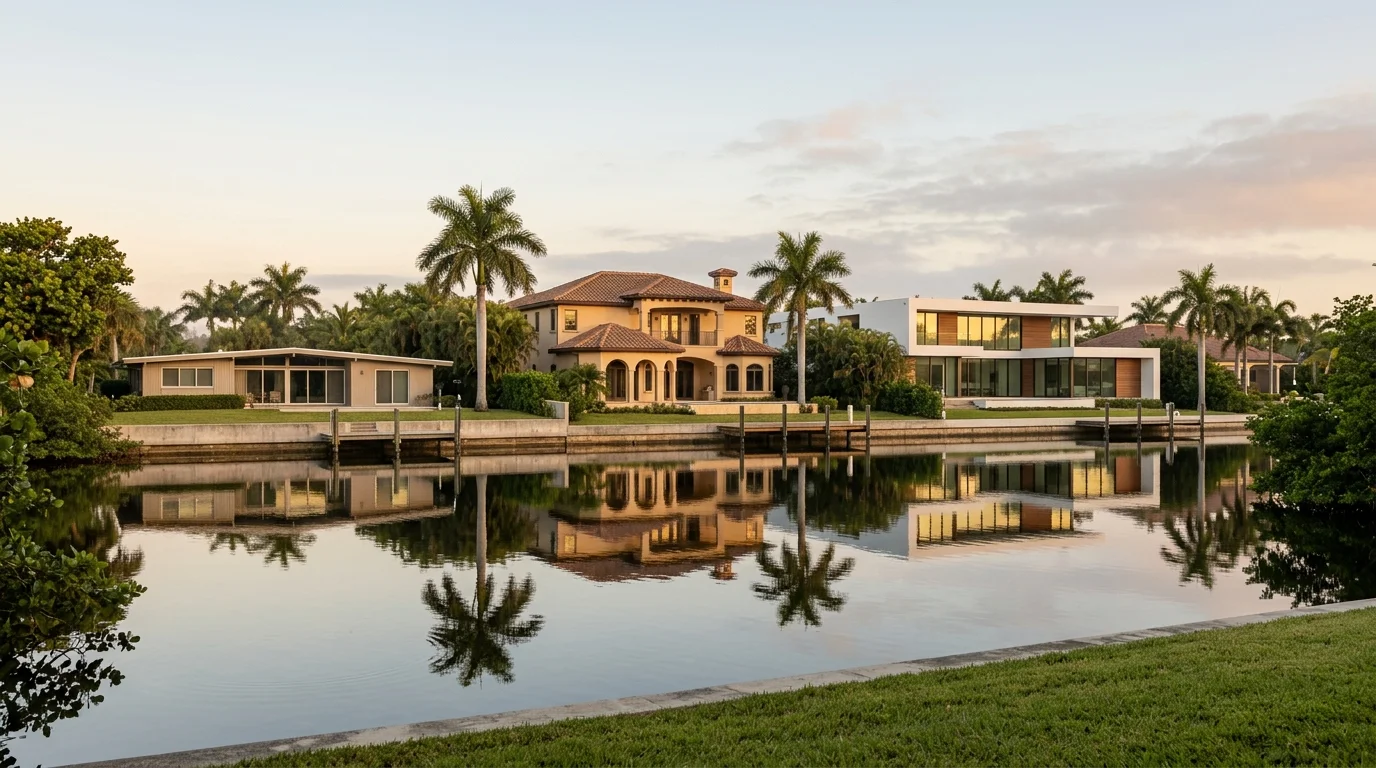
The biggest thing people get wrong about Naples real estate is thinking it is one small, simple market. It is not: Naples is a city of about 20,000 people inside a county of more than 400,000, and the part of town you choose, west or east of US 41, inside or outside the city limits, on the water, near the beach or near downtown, shapes almost everything that follows.
Below are six misconceptions about Naples real estate and the correction for each one, then three objections I hear, and how to tell a real local read from a national headline.
I’m Joe Belz, a Broker Associate at Compass and the lead agent of Joe Belz + Apex Team. I moved to Naples in 1980, I have been in the Naples market since 1990, and I got my start in new construction. My focus is single-family homes west of US 41, in neighborhoods like Olde Naples, the Moorings, Park Shore and Coquina Sands.
If you want to know more about me first, my profile covers my background.
Six misconceptions about Naples real estate
1. “Naples is a seasonal town with one kind of home”
The belief. Naples fills up in winter, empties out in summer, and offers one kind of housing: a condominium, a golf villa or an older ranch house.
The correction. That picture comes from looking at a small slice of the housing stock during a short slice of the year. The range of homes here is wide. Within a few miles of downtown you can buy a condominium in a building near Fifth Avenue South, an original cottage or ranch home on a lot in Olde Naples, a home on a Gulf-access canal with its own dock, a bayfront home with a view across Naples Bay, or a brand-new single-family home built to current code on a lot where an older house used to stand. East of US 41, the stock changes again, with larger master-planned communities, club communities and newer subdivisions.
Downtown Naples is a working downtown. Fifth Avenue South and Third Street South are lined with restaurants, shops, galleries, offices and service businesses. The beaches, the parks and the waterways are in use all year. The town is busier in season, but it does not close.
What to do instead. Look at the housing stock you actually want, in the part of town you actually want, and then visit in more than one season if you can. Walk Fifth Avenue South and Third Street South in the morning and in the evening. My neighborhood pages describe each area, and my guide to new construction in Naples west of 41 shows how much of that stock is changing.
2. “Naples is a small town”
The belief. Naples is a small town, so it is all basically the same place, and you can figure it out in a weekend.
The correction. I like to think of Naples as a small town, but it is not, and treating it like one leads to bad decisions. The US Census Bureau’s latest population estimates put the numbers side by side:
In other words, the City of Naples is a small city inside a large and growing county. A great deal of what people call “Naples” is actually unincorporated Collier County with a Naples mailing address. Housing stock, lot sizes, age of construction, association structure, water access, flood zone designation, the government that issues your building permit and the pace of the market all change as you move across the county.
What to do instead. Stop asking what Naples costs and start asking what a specific part of Naples costs. That brings us to the most important decision you will make.
3. “The house matters more than the part of town”
The belief. Find the right house and the location will sort itself out. A Naples address is a Naples address.
The correction. Figuring out what part of town you want to live in is critical. Most of my clients are golfers, and they live where they want and drive to a private golf club, which is why the club question and the neighborhood question are linked. The neighborhoods where I have done the most business are not golf communities, though the Moorings has a short golf course at The Moorings Golf & Country Club. For golf and club membership, start with Naples golf clubs compared and the Apex Team Golf Club Quiz on our golf courses page. For everyone, there are three questions to answer before looking at a single listing.
West of 41 or east of 41
US 41, Tamiami Trail, is the dividing line most locals use. West of 41, between the highway and the Gulf, you find the older, established neighborhoods: Olde Naples, the Moorings, Park Shore, Coquina Sands, Port Royal, Aqualane Shores, Royal Harbor, Pelican Bay and Vanderbilt Beach. Homes here are closer to the beach, the bay and downtown, and much of the new single-family construction happens on existing lots where an older home is torn down. East of 41, and especially east of I-75, the county opens up into larger planned communities, many with their own amenities and associations. They are different ways of living.
City of Naples or unincorporated Collier County
Some neighborhoods west of 41 are inside the City of Naples and some are not, and a Naples mailing address does not tell you which. It matters more than people expect. The City of Naples has its own building department and issues permits for property inside the city limits, while Collier County’s Growth Management Community Development Department handles permitting in the unincorporated county. That means different offices, different codes and processes, and different people to call when you want to renovate, rebuild or add a dock. If you are thinking about a remodel or a teardown, check the jurisdiction on the property record before you make an offer, using the Collier County Property Appraiser, and then talk to the right permitting office. My guide to buying a teardown lot in Olde Naples, the Moorings or Coquina Sands walks through that process.
Water, beach or downtown
West of 41, most buyers are really choosing between three kinds of daily life, and they are not the same purchase.
| If you want | What that usually means | What to ask |
|---|---|---|
| Boating | A canal or bayfront home with a dock, in areas like Port Royal, Aqualane Shores, Royal Harbor, the Moorings or Park Shore | How long the run is to open water, whether there are bridges on the way, water depth at the dock, and the seawall’s condition and age |
| The beach | A home within a short walk of beach access, or a Gulf-front property | Where the nearest public access is, how the walk feels, and what beachfront ownership involves compared with a home a few streets back |
| Downtown | A home or condominium within walking distance of Fifth Avenue South and Third Street South | How close you want to be to restaurants and activity, and whether you want a single-family home or a condominium |
What to do instead. Decide how you want to spend an ordinary day, then let that decide the part of town, and only then start looking at houses. My on the water page lists fishing charters, sunset cruises and paddleboard tours, and the buyers page explains how we start a search.
Not sure which part of Naples fits the way you live?
Tell me how you want to spend your days here, and I will walk you through the neighborhoods, the jurisdictions and the housing stock that match.
Contact Joe4. “Sellers need to market to international buyers”
The belief. Naples luxury buyers come from all over the world, so a seller’s marketing should be aimed at international buyers.
The correction. International buyers are a very small percentage of our buyers. Roughly 70% of the buyers I work with are second-home buyers, about 25% are relocating executives and about 5% are local moves. Many of those second-home buyers make Naples their primary residence for tax purposes, but they are not moving here to live year-round. Where they come from is in misconception six.
What to do instead. Put your marketing where your buyer actually is. For most homes west of 41, that means the Midwest, Chicago above all, and increasingly the Northeast and California, plus the agents who work with buyers from those markets. International exposure has some value, but a seller should not spend the budget, or the first weeks on the market, chasing a small audience at the expense of the large one. My sellers page and my guide to selling a luxury home in Olde Naples, the Moorings or Park Shore explain how we plan that.
5. “Interest rates don’t impact our market”
The belief. Naples luxury buyers pay cash, so mortgage rates are irrelevant here.
The correction. This one is wrong. Even when a buyer pays cash, rates reach them in several ways. The buyer for their home up north usually needs a mortgage, so rates affect how fast that home sells and for how much. Even a cash buyer is deciding whether to sell investments or borrow against them, and rates change that math. Some buyers choose to finance part of a purchase to keep capital working elsewhere. And the part of the market just below the top, the homes buyers often sell when they move up, is more rate-sensitive, so a slowdown there travels upward. And rates shape confidence; when they move, hesitation shows up in showings and offers.
For context, Freddie Mac’s weekly survey reported the average 30-year fixed mortgage rate at 7.24% as of October 29, 2026, down from 7.32% the week before and up from 6.17% a year earlier. It will have moved by the time you read this. The point is that it matters here too.
What to do instead. If you are buying, talk to a lender early even if you plan to pay cash, so that financing is a choice rather than a scramble. If you are selling, watch what rates are doing to the buyers of the homes your likely buyer needs to sell. My payment calculator is a quick way to see how a rate change affects a monthly payment.
6. “All of NYC is moving here”
The belief. Buyers from New York are pouring into Naples, and they are the ones buying.
The correction. The buyers I work with come from a clear order of places, and New York City is not at the top of it:
- Chicagoland is our largest feeder market.
- The Midwest as a whole, the I-75 crowd, is the largest region.
- Miami and Boston come next.
- The Northeast, the I-95 crowd, historically went to Florida’s east coast. In recent years more of those buyers have started discovering Naples.
- California is trending, and that is new.
Some New Yorkers do buy here. But planning a sale or a search around the idea that “all of New York is coming” leads sellers to market to the wrong audience and buyers to misread the competition. If you are coming from Chicago, my guide to moving to Naples from Chicago covers the questions to work through.
Three objections I hear, and how I answer them
Misconceptions are about how Naples works. Objections are the reasons people give for not acting yet. These are three I hear, and the answers I give.
Objection 1: “Insurance availability and cost are scaring me off”
I take this one seriously. It was a major concern in 2024, and buyers still ask whether insurance costs are rising. But the picture has changed, and buyers who stopped paying attention in 2024 are often working from old information.
Citizens Property Insurance Corporation announced on March 4, 2026 that state regulators approved rates that reduce its homeowners multiperil rates by an average of 8.8% and its homeowners wind-only rates by an average of 5.5%. Citizens said the new rates take effect on July 1 for new policyholders and apply to existing policies at renewal. When it first recommended the cuts in December 2025, Citizens described them as the first average rate reduction for its personal lines policyholders since 2015.
An average is not your premium. Every home is priced on its own characteristics, including its construction, roof, wind mitigation features, elevation and flood zone, and you should never assume a number from a neighbor or an article. Citizens is also not an option for every home: under section 627.351 of the Florida Statutes, a structure with a dwelling replacement cost of $700,000 or more is generally not eligible, so a buyer of a higher-value home should expect to shop the private market. Make insurance part of the due diligence, not a reason to stay out of the market.
How to handle insurance as a buyer
- Get insurance quotes on the specific home during the inspection period, not after closing is scheduled.
- Ask for the elevation certificate, the wind mitigation report and the roof’s age and permit history.
- Ask the question every Naples buyer should ask: did this home get water, and when?
- Check the flood zone on FEMA’s official Flood Map Service Center rather than relying on a listing description.
- Talk to a licensed insurance agent, and compare more than one quote.
My guide to first floor elevation, flood zones and insurance for Naples homes goes deeper, and my due diligence questions to ask before you make an offer put insurance alongside the other questions that matter.
Objection 2: “Prices are still coming down, so I’m waiting”
My first answer is to use local data, not national. A national headline about home prices tells you almost nothing about a single-family home west of 41 in Naples. When a buyer raises this, I show them the local numbers for that home: how much inventory there is and how many sales have closed. What I have been showing buyers is inventory down and closed sales up. The Naples Area Board of REALTORS® reports that in September 2026, overall closed sales rose 2.5 percent to 623 from September 2025, and overall inventory fell 17.3 percent to 4,240 properties, across Collier County excluding Marco Island.
In my view, waiting for a larger correction is the risk at this point. Our luxury market has been the brightest star in this recent downturn. As of September 2026, I was seeing many closed sales in that segment trade 20 to 30% off the ask, which I do not expect to continue as inventory tightens.
Building is a separate question. For my builder and developer clients, I am showing how very few homes are under construction, because many builders are sitting on inventory and cannot buy more until it sells. With a two to three year timeframe to buy a lot, design and build a home, my view is that now is the time to start, given the lack of competition. My guide to new construction in Naples west of 41 explains the full timeline, and new construction is where I started.
Objection 3: “I don’t want to sign the buyer broker agreement”
My answer is a question: isn’t locking me in to do your searching, scheduling, showing, negotiations, inspections, insurance and closing worth it? Off-market opportunities are another big reason to commit to us.
It is also worth understanding what the agreement is:
- Where it comes from. The requirement comes from practice changes that took effect nationally on August 17, 2024, following the National Association of REALTORS® settlement. NAR says that agents who participate in an MLS and are working with a buyer must have a written buyer agreement before touring a home with that buyer, in person or virtually.
- What it must say. NAR says the compensation in the agreement must be clearly defined, for example a flat fee, a percentage or an hourly rate, and not open-ended or a range.
- Whether it is negotiable. NAR says compensation between a buyer and their agent is negotiable and not set by law, and that a buyer can still ask for their agent’s compensation to be paid by the seller.
- What did not change in Florida. Florida’s brokerage relationship law is in Section 475.278 of the Florida Statutes, which presumes that licensees act as transaction brokers unless a single agent relationship or no brokerage relationship is established in writing. The national practice change did not rewrite that law.
The question buyers really want answered is who pays. The honest answer is that it is negotiated every time. In my practice, sellers have almost always covered the buyer’s broker compensation; I have had only one deal where the buyer had to pay, and that buyer knew it when they made their offer. No law requires a seller to pay. Your agreement should say clearly what you would owe if the seller does not.
How to tell a real local read from a national headline
Almost every misconception above starts the same way: a national story gets applied to a specific home in Naples. Here is a test to use with any agent.
Five questions to ask of any market claim
- Where is it measuring? The country, the state, the county or the neighborhood? A county figure blends the City of Naples with communities far east of I-75.
- What price range and property type? Condominiums, single-family homes and new construction behave differently. So do homes at $1 million and homes at $10 million.
- When? Every number has a date. Insurance rates, mortgage rates and inventory all changed meaningfully between 2024 and 2026.
- Who published it, and how? A government agency, an insurer’s filing or a lender’s weekly survey is a different kind of source from an opinion column.
- What does it mean for this house? A real local read ends with a specific home, its street, its elevation, its insurance quote and the recent sales around it.
If you are selling and want a starting point grounded in your own street, you can request a home value estimate, and then we can walk the property together.
Frequently asked questions
No. The City of Naples is small, with an estimated 20,114 residents on July 1, 2025, according to the US Census Bureau. But the City sits inside Collier County, estimated at 417,131 residents on the same date, and many addresses that say Naples are outside the city limits in unincorporated Collier County. That is why choosing the part of town comes before choosing the house.
No. Naples has a wide range of housing, from condominiums downtown and along the Gulf to older single-family homes on original lots, canal and bayfront homes with boat access, and new single-family construction west of US 41. Downtown, Fifth Avenue South and Third Street South are working streets with restaurants, shops, galleries and offices, and the town is active outside the winter season too.
Yes. Even when a buyer pays cash, rates affect the buyers of the homes they are selling elsewhere, their decision to borrow against or sell investments, the part of the market just below the top, and how confident buyers feel. Freddie Mac reported the average 30-year fixed mortgage rate at 7.24% as of October 29, 2026. Check the current rate before you plan around it.
For Citizens Property Insurance Corporation policyholders, yes on average. Citizens announced on March 4, 2026 that regulators approved an average 8.8% reduction for homeowners multiperil policies and an average 5.5% reduction for homeowners wind-only policies, effective July 1 for new policies and at renewal for existing ones. Citizens generally does not insure a structure with a dwelling replacement cost of $700,000 or more, so buyers of higher-value homes should expect to shop the private market. Every home is priced individually, so get a quote on the specific property during your inspection period.
In Joe Belz’s practice, Chicagoland is the largest feeder market, and the Midwest as a whole, the I-75 corridor, is the largest region. Miami and Boston come next, buyers from the Northeast are increasingly choosing Naples, and California is a newer and growing source. International buyers are a very small share of his buyers.
Look at local data for the specific neighborhood and price range, not national headlines. In Joe Belz’s view, waiting for a larger correction is the risk at this point. If you plan to build, remember that buying a lot, designing and building a home can take two to three years.
If you want an agent who participates in the MLS to tour homes with you, generally yes. Under practice changes that took effect on August 17, 2024, NAR says a written buyer agreement is required before touring a home, in person or virtually. The agreement must state the compensation clearly, and NAR says that compensation is negotiable and not set by law. Florida’s brokerage relationship law did not change.
It is negotiated in every transaction. A buyer can ask the seller to cover the buyer’s broker compensation as part of the offer, and in Joe Belz’s practice sellers have almost always covered it. But no rule requires it, so your written buyer agreement should state what you owe if the seller does not pay.
Related resources
- About Joe Belz, Naples real estate broker at Compass
- New construction in Naples west of 41
- Buying a teardown lot in Olde Naples, the Moorings or Coquina Sands
- Naples home buyer due diligence: questions to ask before you make an offer
- First floor elevation, flood zones and insurance for Naples homes
- Selling a luxury home in Olde Naples, the Moorings or Park Shore
- Moving to Naples from Chicago
- Naples neighborhoods
- Buying in Naples
- Selling in Naples
Talk to Joe about your home or your search
Whether you are buying, selling or building, the first conversation is about the part of town, the specific home and your timing, using local information rather than headlines. Reach out and let’s talk it through.
Contact JoeSources
- US Census Bureau, Population Estimates Program, Vintage 2025 county and city population estimates (July 1, 2025), census.gov
- Freddie Mac, Primary Mortgage Market Survey, weekly averages as of October 29, 2026, freddiemac.com/pmms
- Citizens Property Insurance Corporation, “Citizens’ 2026 Multiperil Rates to Drop Statewide,” March 4, 2026, citizensfla.com
- Citizens Property Insurance Corporation, “Citizens Recommends Rate Cuts for Most Policyholders,” December 10, 2025, citizensfla.com
- National Association of REALTORS®, “Consumer Guide to Written Buyer Agreements,” nar.realtor
- Naples Area Board of REALTORS®, September 2026 Market Report release, October 23, 2026, naplesarea.com
- Florida Statutes, Section 475.278, Brokerage relationships, and Section 627.351, Insurance risk apportionment plans, flsenate.gov
- City of Naples, Building Department, naplesgov.com
- Collier County Growth Management Community Development Department, collier.gov
- Collier County Property Appraiser, collierappraiser.com
- FEMA Flood Map Service Center, msc.fema.gov
Figures are current as of October 30, 2026, the date they were checked. Mortgage rates change weekly, and insurance rates, flood maps and brokerage rules change over time. This article is general information about buying and selling real estate in Naples and Collier County, Florida. It is not legal, tax, insurance or financial advice. Confirm anything specific to your property or your circumstances with the appropriate licensed professional, your insurance agent, your lender and the relevant government office.
Social Cookies
Social Cookies are used to enable you to share pages and content you find interesting throughout the website through third-party social networking or other websites (including, potentially for advertising purposes related to social networking).